
Scenario Planning Playbook
Scenario Planning
Helps Ensure Alignment
Scenario planning allows your executive team to prepare for the unexpected while making calculated, less reactive decisions. It forces your leaders to stretch their thinking, imagine plausible futures, and build plans for multiple outcomes.
This structured process builds alignment across your team about what’s possible — and what your coordinated response could look like.
Why it matters:
When uncertainty strikes, the last thing you want is each leader interpreting the situation and reacting independently. Scenario planning gets everyone on the same page about potential disruptions and how to navigate them — before they happen.
Executive Team Only — Behind Closed Doors:
This is about surfacing the “scary stuff” in a safe space, building contingency plans, and locking them away until needed. Some scenarios may require immediate action (like ramping up talent acquisition if you foresee labor supply risks — a real example one Bright Arrow client navigated successfully). Others simply sit on the shelf, ready to be activated if specific triggers occur.
Logistics of Scenario Planning –Building a Repeatable Process
Step 1: Define Objectives & Scope
What external disruptions are most likely to affect your
business (economic shifts, tech advancements, regulation)?
What internal vulnerabilities could amplify these risks
(talent shortages, operational dependencies)?
Step 2: Identify Critical Uncertainties
What are the 2-3 biggest unknowns that could significantly impact your business? These might be factors like global supply chain disruptions, AI regulatory frameworks, or shifts in customer behavior.
Step 3: Develop 3-5 Plausible Scenarios
Using those uncertainties, construct a range of possible futures.
Example:
Scenario A – “AI Hyper-Acceleration”: Rapid adoption unlocks new efficiencies but requires workforce reskilling.
Scenario B – “Regulatory Squeeze”: Compliance costs skyrocket, slowing innovation.
Scenario C – “Talent Crunch”: Skilled labor becomes scarce, forcing automation investments.
Step 4: Stress-Test Strategy Against Each Scenario
How does our strategy hold up in this future? Where would we need to pivot?
This builds clarity around what initiatives might be triggered or paused.
Step 5: Assign Ownership
Ensure each scenario has a clear point person who monitors related indicators and flags when action may be required.
Step 6: Document Decisions & Decision Logic
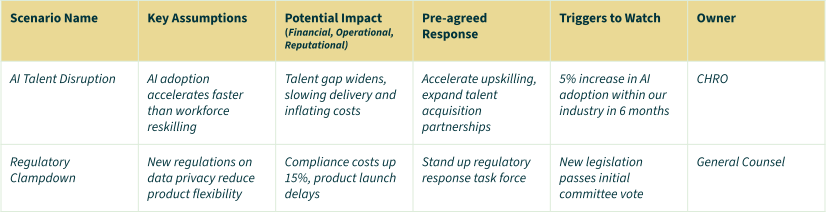
Maintain a Scenario Planning Workbook (shared across the executive team) that captures:
- The scenario narrative
- Assumptions behind it
- What triggers activation
- Pre-agreed responses (initiatives, investments, messaging changes)
This documentation prevents your team from revisiting the same debates every time volatility reappears.
Template Example – Scenario Documentation Snapshot

Create Clarity — Even in Ambiguous Situations
After the behind-closed-doors scenario planning, you decide what to communicate and to whom. Your workforce needs to see a unified executive team, calmly and confidently steering the ship — even when you don’t have all the answers.
The goal: Ensure the broader workforce, so they understands where the business is headed and how priorities may shift — without overwhelming them with uncertainty.
Clarity About What?
- What key initiatives may emerge in response to volatility?
- What existing work will be paused or de-prioritized to make space for urgent new work? (Create a clear backlog.)
- Who has decision-making authority when a scenario is triggered?

Don’t Go It Alone —Rely on Experts
Bright Arrow Coaching is an Executive and Leadership Team Coaching firm that can facilitate your executive team's planning for the future. If you need high caliber, expert coaching for your team that will allow your leaders to show up, deliver their best expertise, and get them back into the field, we’re here and ready to help.

▶︎ Ready to elevate your team? Contact Bright Arrow today.
visit:
brightarrowcoaching.com
or email us at:
hello@brightarrowcoaching.com